The vegetation of Gavdos in the Holocene

The vegetation of Gavdos in the Holocene

door Annemieke van Roekel

Main sources of this article:

Bottema, S., Kopaka, K., Alexopoulos, A. 2003, The Late-Holocene vegetation history of Gavdos (Crete) in relation to long-distance pollen dispersal: the Trypiti pollen diagram0, in S. Tonkov (ed.), Aspects of Palynology and Palaeoecology. Festschrifft in honour of E. Bozilova, Sofia-Moscow, 199-212. Link to this article.

Bergmeier E, Jahn R, Jagel A (1997) Flora and vegetation of Gavdos (Greece), the southernmost
European island. 1. Vascular flora and chorological relations. Candollea 52: 306-358. Link to this article.

Getting to know the important plants of Gavdos and Gavdopoula. 2022 Mediterranean Agronomic Institute of Chania (CIHEAM – MAICh). Link to this guide.
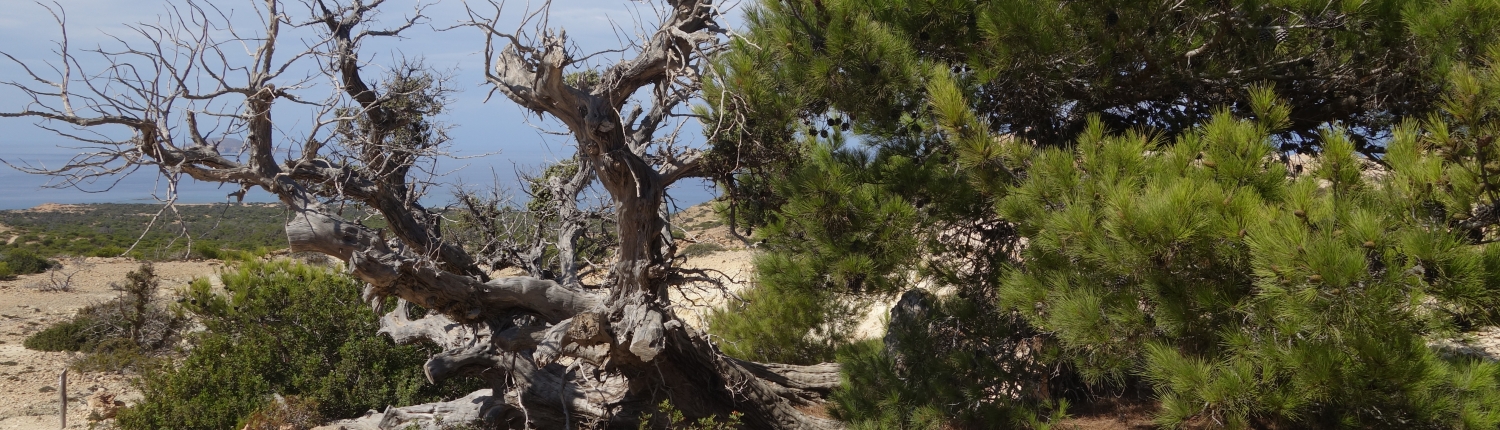
The tree vegetation of Gavdos is characterised by two species of juniper, lentisk and turpentine pine, the latter of which has only recently appeared. Pollen from three locations (e.g. lagoon of Trypiti) was analysed; the 3,000-year-old pollen showed birch and oak, species that are not present on the island today. Birch and oak are also scarce on nearby Crete. Low pollen values were also found for pine, which contrasts with the situation today. Turpentine pine is now abundant, as it is in the neighbouring part of Crete and in other areas of the eastern Mediterranean.

The first botanical investigation was carried out in the 16th century. The Venetian naturalist Prospero Alpini visited Gavdos and Gavdopoulo in 1584. The results were described in ‘The Plantis exotics’, published in 1627 (online available). More than half of the described plants are from the Cretan area (Bergmeier et al. 1997).

In 1904 the first modern plan investigation was made by the Austrian botanist Ignaz Dörfler; in his publication (1935) 137 plants from Gavdos were recorded (Bergmeier et al. 1997).

Systematic archeological research on Gavdos has been conducted for over 30 years. In the last three decades, the island’s archaeological sites have been systematically mapped, its vegetation studied, and the extent of prehistoric human influence on ecosystems investigated.

Gavdos lies in the Lybian Sea (25 E; 36 N) and covers a surface of 33 sq. kilometres. Two thirds of the island is covered by Neogene sediments (conglomerates, sands, marls, sandstones and marly limestones) and Quaternary sediments (Pleistocene limestones, calcareous sandstone, aeolianites, sands and sand-dunes and fossil rich sea terraces (Bottema et al, 2003).

Tectonic forces are very well visible in the rocks in the southern and western part, as the island’s position is at the subduction front; here the African tectonic plate dives below the Eurasian plate. Folded sediments and layers in an almost vertical position of the Pindos unit are exposed esp. in coastal areas, e.g. near Lakoudi beach towards the beach of Trypiti in the south. The basin of Trypiti (one of the pollen sources) is a result of tectonics and erosion; the morphology follows a natural fold in the Pindos rocks.

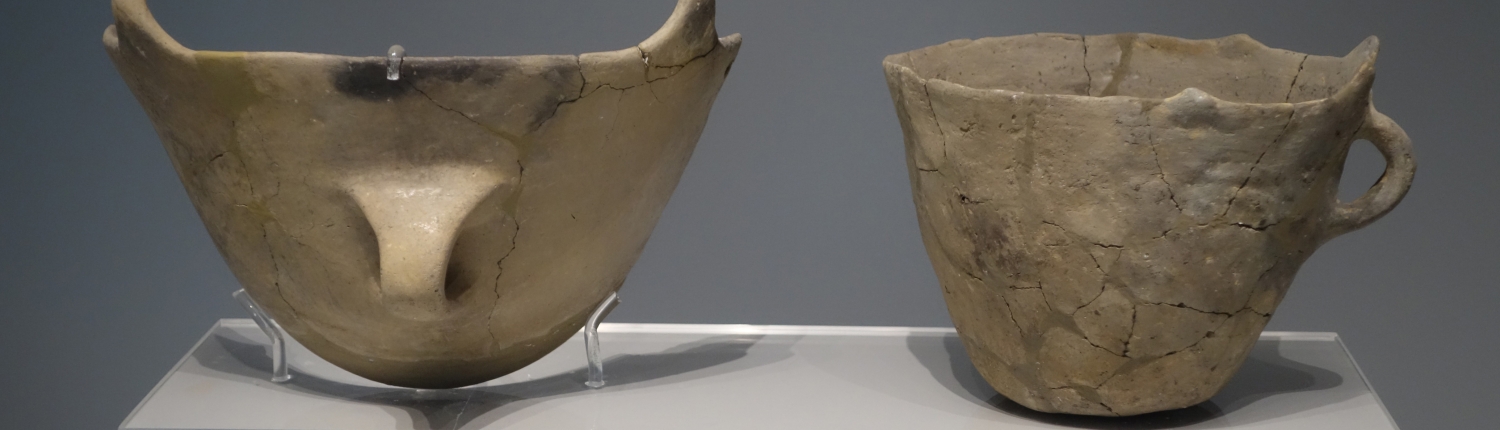
Archaeologists have found evidence of early colonisation of the island dating back to the 4th millennium BC. There was more recent occupation during the Bronze Age and in Greek and Roman times, continuing into the modern era. Gavdos’ position has always placed it at a maritime crossroads. There is a Venetian ruin in the north-west and various ancient authors mention Gavdos (I still need to find the sources for this). Minoan pottery is one of the archaeological treasures, mostly from the Early- and Middle Minoan periods (corresponding to the Prepalatial and Protopalatial periods).

Until the Second World War, less than 10% of the island was covered by trees. Nowadays, pine and juniper trees cover large parts of the island. In the past, juniper wood was used for building houses, and old ruins still contain intact juniper branches and prevent the ruin to deteriorate further. The main tree species are Pinus brutia, Juniperus macrocarpa and Juniperus phoenicia. Pinus grows on old agricultural terraces, and the remains of these terraces suggest that there must have been a highly developed agricultural economy in ancient times.

The protected dune landscape with the juniper trees is marked as “Kedros” on maps, but this is not related to the cedar tree. The lower shrubs are Pistacia lentiscus. I came across some carob trees in dry river valleys, but they are scarce.

foto carob

geit

Prospero Alpini in 1584

zie bergmeijer

  • View from the sea near Trypiti on the unconformity horizontal Neogene - vertical Pindos sediments. Photo: Annemieke van Roekel

  • Pindos rocks in almost vertical posotion at Lakoudi beach. Photo: Annemieke van Roekel

  • Lakoudi beach, cliffs of almost vertical Pindos sediments. Photo: Annemieke van Roekel

  • Beautiful folded rocks North of Lakoudi beach. Photo: Annemieke van Roekel